

Ultrafast portable camera with encoded light illumination
Advantages
- Ultrahigh-Speed Framerates: Features sub-nanosecond response times capable of generating images up to 1 million frames per second (1M fps).
- Unmatched Cost Efficiency: Utilizes low-cost components.
- Compact & Lightweight: Portable form factor allows easy integration into mobile systems, drones, and field inspection units.
- High Signal-to-Noise Ratio: Simultaneous multi-LED illumination enhances image quality and signal clarity without complex multi-pixel sensors.
- Multispectral Versatility: Flexible architecture compatible across visible (RGB) and short-wave/mid-wave infrared (IR) spectral bands.
Goal
The group is looking for a license agreement, but other collaborations may be considered.
Patent
PCT/EP2025/077996
Priority date: 30 September 2024
Reference
UBTTT0484
Contact
Dr. Sancho Moro
Email: smoro@fbg.ub.edu
Ultrafast portable camera with encoded light illumination
Executive summary
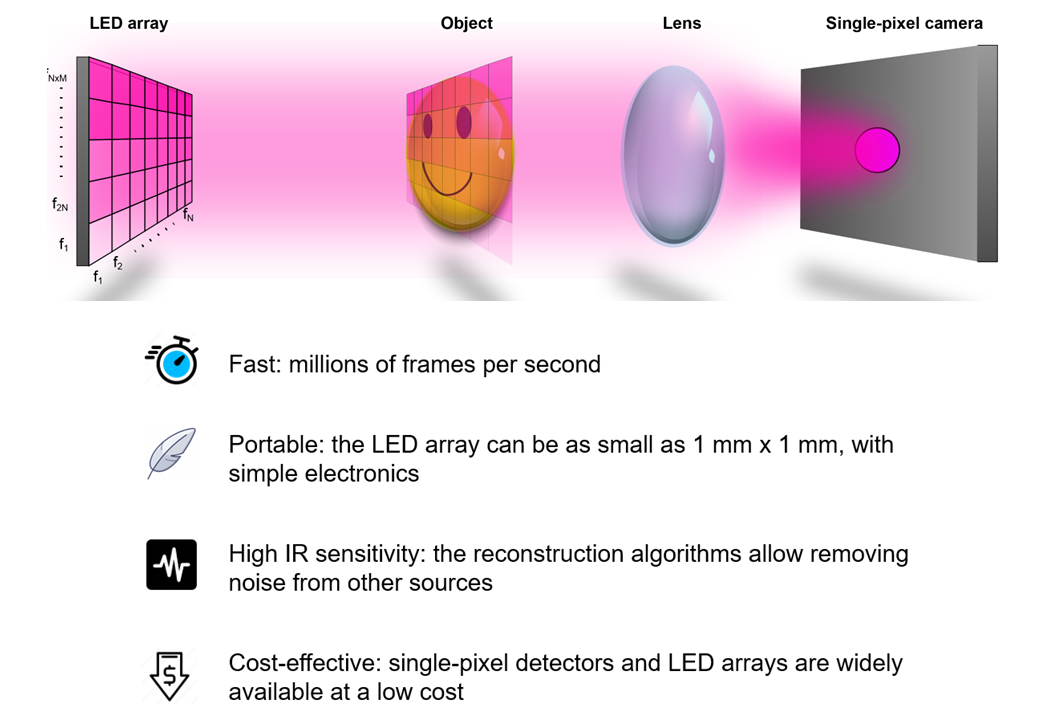
Researchers at the University of Barcelona have developed an innovative single-pixel infrared (IR) camera that reconstructs high-resolution dynamic images using spatio-temporal light encoding. By coupling a single-pixel detector with a custom, frequency-modulated LED matrix, the system achieves sub-nanosecond response times and frame rates of up to 1,000,000 frames per second (1M fps). Built with highly cost-effective components, this lightweight and portable camera eliminates the high cost and bulk of traditional multi-pixel infrared arrays, offering a scalable solution for high-speed industrial inspection and scientific research.
Description
The imaging device employs spatio-temporal light encoding to overcome spatial resolution limits inherent to single-pixel detectors. The system uses an array of individually addressable light-emitting devices (such as an LED matrix) to illuminate specific regions of a target object. Each LED in the matrix operates at a unique flickering frequency. As light is reflected or emitted from the sample, it is collected by a single photodetector with sub-nanosecond response time. Advanced post-processing algorithms decode the frequency-multiplexed signal to reconstruct high-resolution images with exceptional temporal and spatial fidelity. By illuminating the entire target simultaneously with multi-LED spatial encoding, the device maintains a high signal-to-noise ratio and can capture ultra-fast transient phenomena up to 1,000,000 fps.
The spectral range of the camera is determined by the detector used:
-
InGaAs: 900-1700 nm (up to 2700 nm).
-
Germanium: 800-1700 nm.
Current stage of development
The technology and fabrication process is well established and the material can be produced for a wide range of applications.